Making sense of your money.
Free, plain-English guides to help you plan your route to financial freedom.
- Free, no account needed
- No products to sell
- Written for the UK
The Ask Axel app
Learn money in 3 minutes a day, on your phone
Everything on this site, made personal. Tell Ask Axel your pay and savings once, and every lesson, calculator and answer uses your own numbers.
- 26 short lessons on tax, saving, ISAs, pensions and investing
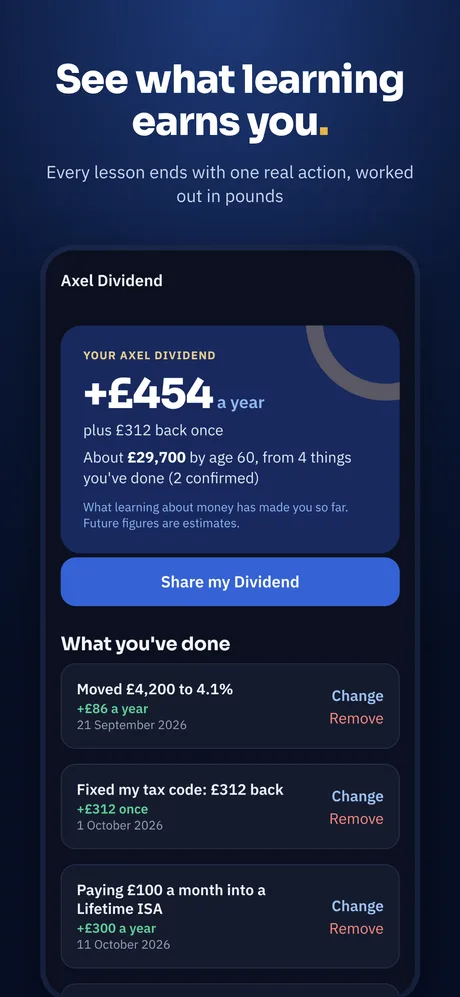
- The Axel Dividend: every lesson ends with one real action, and we show what it's worth to you in pounds
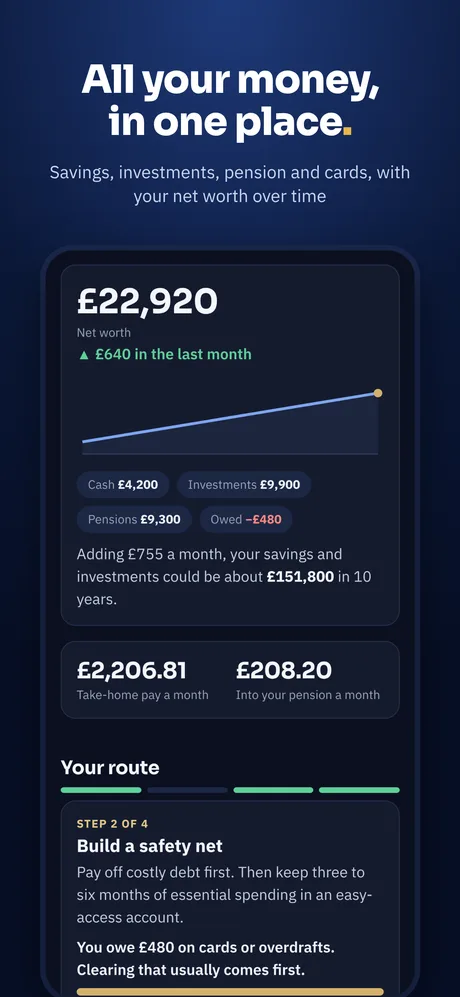
- Your net worth in one place, with where it could be in 10 years
- Ask Axel, an AI assistant that answers with your own numbers
Free on iPhone and iPad, in the UK.
The route to financial freedom
Four steps, in the order financial planners often suggest. Start with the first one you haven't done yet. Not sure where you are? Take the one-minute check, or start from zero with Money basics.
-
Step 1: Spend less than you earn
Know where your pay goes each month and make sure a bit is left over. Everything else builds on this.
Read the guide -
Step 2: Build a safety net
Pay off costly debt first. Then keep three to six months of essential spending in an easy-access account.
Read the guide -
Step 3: Take the free money
Stay in your workplace pension and pay in enough to get your employer's full contribution. That money is part of your pay.
Read the guide -
Step 4: Pay yourself first
On payday, put some aside for future you before anything else. Invest it and give it time to grow.
Read the guide
Free calculators
Put in your own numbers. Nothing you type is stored.
-
Take-home pay
What lands in your account after tax, National Insurance, your pension and any student loan.
£30,000 is about £2,014 a month Open the calculator -
Compound interest
What regular saving could grow to, and how much fees could take.
£100 a month from 22: about £135,800 by 60, at 5% a year Open the calculator -
Your savings in one picture
Add up your ISAs, pension and savings and see how they could grow together.
Every account, one total Open the calculator
Why starting early matters
Starting ten years sooner can nearly double what you end up with. Move the slider to try your own amount.
Starting at 22 rather than 32 means paying in £12,000 more, but ending up with about £62,800 more.
Try the full compound interest calculatorSee what waiting really costs
Common questions we get asked
Quick answers to the things a lot of people wonder about once they start earning.
How much of my pay should I be saving?
There's no magic number. A popular starting point is the 50/30/20 rule: around half your take-home pay on needs, 30% on wants and 20% on saving or paying off debt. If rent takes up more than half, you're far from alone. Start with whatever you can manage, even £25 a month, and nudge it up when your pay goes up.
How to budgetShould I pay off debt or save first?
Usually a bit of both. Many people keep a small starter fund, say £500 to £1,000, so a surprise bill doesn't go straight back on a card. Then they clear expensive debt like credit cards and overdrafts, starting with the highest interest rate. Student loans are different, because what you repay depends on what you earn.
Building a safety netWhat's the difference between a cash ISA and a stocks and shares ISA?
A cash ISA is a savings account where you don't pay tax on the interest, and your balance won't fall. A stocks and shares ISA holds investments like funds, so its value goes up and down, but over the long term it has tended to grow faster than cash, though that isn't guaranteed. You can have both, as long as you pay in no more than £20,000 in total across your ISAs in 2026/27.
What is an ISA?How much money do I need to start investing?
Less than most people think. Lots of platforms let you start with small monthly amounts. What matters more is that it's money you won't need for at least five years, and that your safety net is already in place.
How to start investingIs investing just gambling?
No, but it isn't risk-free either. A bet rides on one outcome. A fund that holds hundreds of companies gives you a small share in how they all do over many years. Prices will fall at times, sometimes sharply, which is why investing is for money you can leave alone for at least five years.
What is investing?Why is my first payslip lower than I expected?
You might be on an emergency tax code, which often happens when HMRC doesn't have your details yet. Or your first pay might only cover part of a month. Emergency codes usually get corrected, and any extra tax you've paid normally comes back through your pay.
How to read your payslipDoes checking my credit score lower it?
No. Checking your own report is a soft search, and lenders can't see it. Only full credit applications leave a hard search on your file. And student loans from the Student Loans Company don't usually show up on your credit report at all.
Credit scores explainedIs my money safe in a bank?
Money in a UK-authorised bank or building society is protected by the FSCS, up to £120,000 per person, per institution. Some banking brands share one licence, so that limit covers them together. You can check which brands are linked on the FSCS website.
Where to keep your safety netWays to save and invest
The main options side by side, so you can see what suits you.
-
Emergency funds
Three to six months of essential spending, somewhere easy to get at.
Good for the unexpected -
Cash ISAs
Interest you don't pay tax on, and no investment risk.
Good for short-term saving -
Workplace pensions
Saving for later life, with a top-up from your employer and tax relief.
Good for retirement -
Stocks and shares ISAs
Invest up to your yearly allowance and pay no tax on what you make.
Good for tax-free investing -
Lifetime ISAs
The government adds a 25% bonus towards your first home or later life.
Good for a first home -
Index funds
One low-cost fund that owns a small slice of lots of companies.
Good for low-cost investing
Get our monthly email
One short email a month: our new guides, plus any rule changes you'll want to know about. Sign up and you'll get our free first job money checklist straight away. No spam.
We'll only use your address to send you our monthly email. Read our privacy notice.